Tuesday, February 17, 2015

Painting the Living Room


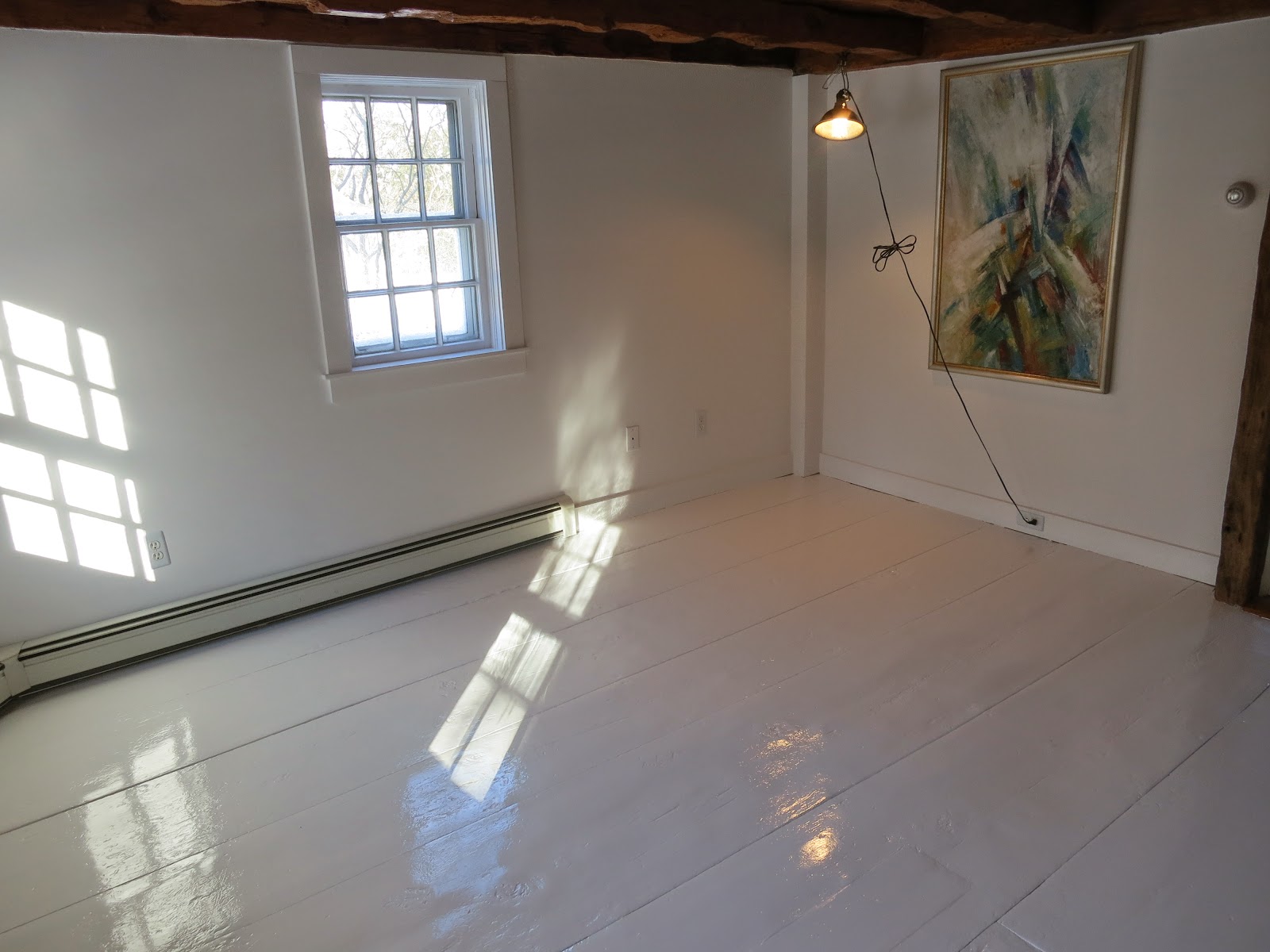
Bill drove us through a blizzard this holiday weekend... to experience a big blizzard at Old Farm and paint the living room floor while sequestered there. This original floor was the last of the living room to be painted, but needed a very wide board patched first.


We used an original old floor board from upstairs (which was removed to create the stairs cathedral ceiling), for the patch. It was ship-lapped on all four sides for a tight fit. Luckily the floor here had been reinforced with sub-floor boards, although they needed much chiseling and disc-sanding for installation. This patch is in one of three prominent boards near the hearth which measure about 22" wide. On a colonial house first floor, boards this wide were a status symbol and taxed by the English.


Bill meticulously cleaned the floor board joints with a puddy knife's edge and vacuum nozzle before disc sanding and priming them. This room faces South and is sunlit nearly all day. It is also 12' square, so painting it all white and adding a large mirror was an easy decision.


With temperatures in the single digits, we ran our wood stove and fans all night to finish the painting and leave just before the next heavy snowstorm hit. The walls in this room were painted Benjamin Moore's Eggshell White, the trim and wood wall boards are Benjamin Moore's Satin White, and the floor has two coats of an oil based white after white primer.


Above the fireplace looks to have original paneling around our third new flu and rebuilt chimney.


 A parting snow shot...


Monday, February 9, 2015

Snowed In


While restoring Old Farm making monthly visits from New Jersey, there have been times when we have been snowed in here or there. Here we are snowed in New Jersey and then plowed...


We have missed getting to Old Farm this year because of severe snowstorms there and cold everywhere. The winter we bought Old Farm, we managed to gut the upstairs in an 18" snowstorm with the boys help - whew.

Wednesday, October 15, 2014

Upholstering a Headboard


Here is the antique Irish headboard I decided to have upholstered in the last yard of room fabric I had left; using the lighter side of the fabric. I bought the upholstery batting thinking I would do the work myself like the upstairs headboards, but all those curves and the cost of $125.00 to have it done with $40.00 more to have double piping added allowed me to afford having it professionally done with 1" foam underneath as well.


Two layers of thick batting were added to the upholstery foam, creating a very well padded headboard. The fabric was stretched smoothly over all of this and the cording I had made of thick white denim fabric is so tightly fit around the edges. (The lower curve will go around an outdoor light switch I was concerned about.)


The back has upholstery linen added to the bottom, but I will still be able to reattach the long boards that serve as legs when we decide how high we want this headboard to be.


Here it is in place and mostly hiding the outdoor light switch next to it, which is a good thing.

The headboards in the upstairs guest room I was able to sew myself using left-over fabric, two layers of thick batting, single cording and cotton duct covered thick cardboard for the back which velcro attaches to the headboards. These cost $20.00 for the materials I needed...save and splurge.

Tuesday, September 2, 2014

Restoring a Vintage Weber Grill


Alex was encouraged by friends to rescue this cast-out vintage (about 1995) Weber grill... and some sister parts, he found on the streets of Charlestown, MA where he lived. Like our Jeep Wrangler '95, this was the end of a heavy metal era while the upgrades are impressive enough and the size just right for Old Farm. Although Alex began the restoration, Christian was able to complete the project before our Labor Day family picnic here.

Most of the parts came from internet sources since restoring these grills has become a cult club it seems. Christian made the wooden pieces he sealed though to replace the plastic slats, which is a wonderful look I think. This was a complete disassembly and rebuild with some upgraded parts, and utensils from Ocean State Job Lots. The propane tank was another free find.

Here is a link to the process: http://imgur.com/a/3m6e4


Here is a second vintage Weber that Christian restored for his old farmhouse in Hopewell. The handle was made from a fallen Sycamore branch with a live edge left on it. There are many large; beautiful Sycamore trees here.

Plenty of Pears


There are fourteen fruit trees that border Old Farm and the pear trees are the most bountiful.


Anders is lucky to be allowed any pear fallout he often lies in wait for.


Beyond the pears are the four year old Nikko Blue Hydrangeas I transplanted this Spring, whose bloom colors have been shifting as they adjust to their new soil surrounds.

Saturday, September 14, 2013

Anything Goes With Gustavian


Anything you love to live with or in, looks good with Gustavian furniture, I think; old, new, Retro, or rough. Bill uses our dining room in Hopewell to dry many of his clay pieces and our chairs are often supporting platforms of clay chunks or pieces set under the ceiling fan; however, it looks lovely to me.

Tuesday, September 10, 2013

Custom Building A Screen Door


We hung the screen door Bill built with all solid brass hardware, mostly from the "House of Antique Hardware". Below is an old screen door spring the local hardware store gave us, which is mounted with an inch of tension: "thwap!"


Building the Screen Door...


Alex suggested a screen door for the front of Old Farm, and we all immediately liked the idea since it would allow more light and air into the front of the house. Bill got to order a new tenon joiner machine (open box price from Amazon), copper screening, and solid brass hardware, while I got to design it like a few favorites I had seen in Nantucket.

After fitting the door on site, Bill has routed the screen area edges here where he will paint the door and screen stops before assembling it all. The screen gets stapled into place and stops (mitered trim) are nailed over the edges..


Although the craigslist biscuit joiner Bill bought to enlarge the closet door could have been used here, he was convinced that an exterior door would last much longer with tenon joints (and Titebond III glue). I decided on 4" clear pine stiles and 9" bottom board which allowed us to order a 5' stock piece of copper screen and trim the door to it's trapezoidal opening shape.

.
Installing a Screen


While the screen stops are off, the new screen (this one is 90% copper + 10% zinc to keep from turning green) is cut to size with wire cutters and laid in place. A staple gun and 3/8" staples are used to secure the screen.


The screen stops are then fit into place and 5/8" brads are used to nail them in place.


We made protective screen bars to mount on the front and back of the door, which are secured with solid brass screws.


The screen door below appears to have nice new copper screening which looks wonderful with the color paint around it. This is the Tate House, built in 1775 on the coast of Maine for the Senior Mast Agent for the British Royal Navy, who oversaw the cutting and shipping of white pines to England. Note: All tree trunks 24" and wider were marked with three axe slashes and claimed for the English King to be used as ship masts, which is why we haven't any boards of this size at Old Farm, but almost.


Below is the screen door on the Union Street Inn in Nantucket, and a favorite. The bars help with high traffic, and mostly boys in the house in our case. Ours has 5; 1 1/4" bars outside, and 3 inside. The cost of the materials was about $100.


The inside of our front door is now painted a light blue/green "Glacial", by Restoration Hardware in Benjamin Moore gloss paint which we had specially mixed. It will also be used on steps across from the door inside.


This door finally got an old indoor handle we found here and a hand forged slide bolt from "Fagan's Forge" besides the latest in weather stripping of three different sizes (Bill read about from "This Old House") which makes it shut like a refrigerator.


I love green painted doors of all shades, from English black/greens to paler shades like the color of Bucklebury Manor's front door, where Kate Middleton's parents live on a Georgian Estate.


What's built behind this door is quite impressive. There are solar panels on a newer roof and I plan to put two large skylights in the front roof of Old Farm, which will be as radical an idea I hope.


Pictures from "mylusciouslife.com".

Outside of our front door are some very old original plantings, gardens refurbished, a hammock when on vacation, and stacked firewood for winter.